Kilgallen in Hollywood

I wrote this little thing last year, after reading Lee Israel’s biography of Dorothy Kilgallen. I picked the parts of the story one could relate to the movie business in some way. At the time, I was planning to do these “Old Hollywood stories” on the blog once every while. Clearly, it did not work out. But I wanted to publish something to make myself more motivated to write.

In 1936 New York journalist (from New York Evening Journal) Dorothy Kilgallen, who was only twenty-three at the time, boarded the German ship Hinderburg and set off on a journey around the world. The idea was for her and two other journalists to race and see who can get back to the US first, in the spirit of Around the World in 80 Days. To the public, Kilgallen was the most exciting part of the whole expedition because she was a woman — and everyone was wondering if a woman could accomplish such a feat. Of course, all three travelers would write about their journey in their respective magazines, and the Americans would „tune in” to see how they are doing.

The journey was full of adventures and drama and twists and turns, even before it really started. Still aboard Hinderburg, Kilgallen met and fell for a German general. A general that was, as it turns out, one of the soldiers from the immediate circle close to Hitler. Not only that but when the travelers got to Germany, Dorothy openly talked about her appreciation for the land. She thought that the Germans truly knew how to run the country. On the other hand, she hated Baghdad and other „Arab” places, called them dirty, made fun of the customs and traditional clothes. She also described Indochina as a jungle where primitive tribes hunt helpless white women. She evidently enjoyed the postcolonial narrative-fantasy of a poor white woman against the savage tribes of the „exotic” lands.

Maybe in 1936 the ignorance about what was happening and what was going to happen in Europe very soon was widespread enough that we could try and look past Kilgallen’s sympathies.  But we can all agree that being that into German officers was not something to be proud of. The comments about the Middle Eastern, Asian countries alone prove that xenophobia and fear of anything foreign was a big part of Kilgallen’s columns. Did people care in 1936? Some of them, sure, but I am afraid that her sentiments were in a large part shared by the 1930s America. So her comments did not cause the backlash they might have if her column was being published today, in fact the public’s response to Dorothy was rather enthusiastic. Even after one of the other journalists, Ekins, ended up being the winner of the race, it was Dorothy who the Americans were most excited about. She became a celebrity. And she would soon set off on a new journey, a journey to a place where celebrities go — Hollywood, California.
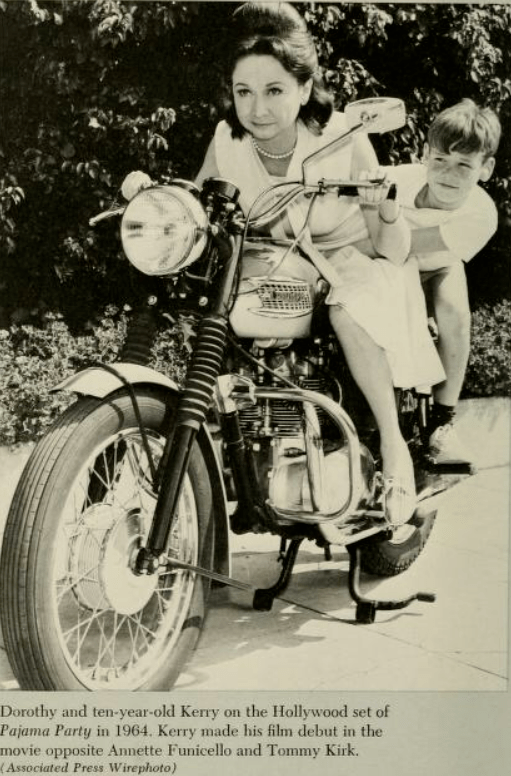
After the competition Dorothy Kilgallen became a staple of popular culture. She appeared in ads, interviews, people started writing books and songs about her. Plus, Hollywood decided to make a movie based on her adventure. The film was called Fly Away Baby and changed the story „slightly”. In the film, the character based on Dorothy won the race, the character based on Kieran, another journalist, cheated. Dorothy herself appeared in a movie called Sinner Take All — she got a cameo as a reporter. Originally she had five lines of dialogue but in the final version of the movie they were cut to just one. There wasn’t really a big movie career in Dorothy’s future.

So, there was an actual Dorothy Kilgallen — although appearing under different names, in the movies in Hollywood, but the real life Kilgallen also quickly became part of the industry. She was a writer first, so it made sense for her to get her own Hollywood column. It was first known as Evening Journal: Hollywood Scene as Seen by Dorothy Kilgallen, and later changed to As Seen in Hollywood by Dorothy Kilgallen. While there were definitely parts of the Hollywood life that impressed Dorothy, at her first exposure to the place she was quite shocked by the way of life there. She was not used to the very common informality of behaviours and the language. And she was rather critical of the stars, using her column to write snarky comments about Hollywood’s biggest names. 
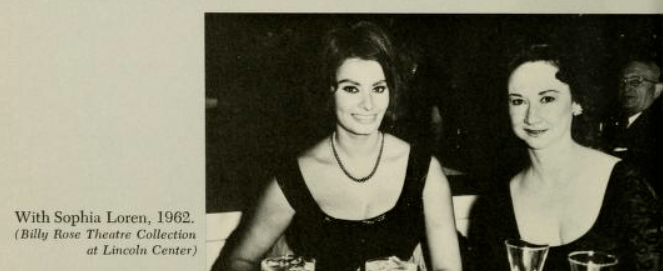
Dorothy was not a fan of, what seems like, the majority of stars of the era. She regularly wrote snarky article about stars like Simone Simon or Constance Bennett. Actually, Constance Bennett was at that time feeling pretty militant and ready to fight anyone who has done her wrong. What that means is that she was suing everyone who slandered her name in some way. So there came a time for Dorothy as well, and Constance had the support of none other than Louella Parsons. That does now mean, though, that there were no stars that she respected. Take the likes of Myrna Loy (because she was bad at sports, and women ought to be bad at sports), Henry Fonda (because he was „very New York” — whatever she meant by that, it was obviously something Kilgallen, a native New Yorker, appreciated in the West), Loretta Young (because she was pretty), and she simply LOVED Tyrone Power.

Quite a lot could possibly be said about Kilgallen and Tyrone Power (if we could actually pin down reliable sources, Lee Israel’s book threads the subject rather carefully): let’s just say that her admiration for him went beyond his career. Or, to put it more bluntly, she developed a real, high-schoolish crush. There is some debate as to whether the couple actually… was a couple, but I think it is pretty safe to say that there was at least one-sided attraction between them. In fact, during the period of time when Dorothy and Tyrone were part of the same social scene, she published a short romantic story in Cosmopolitan called Holiday for Hollywood which (apparently, I have not been able to find it) was a not-so-subtle reference to the actor. The big romance part of the story is questionable.

With the Bennett conflict and Tyrone Power getting married (to someone else), there was not much left for Kilgallen in Hollywood. That period allowed her to get to know a whole new world but was not exactly a grand success. So she went back home to New York City. Her social circle changed only slightly because she continued to write about affluent people, the so-called Cafe Society. She became a Broadway reporter which was a big thing back in the day as it was, apparently, a „man’s job” and Kilgallen was the „First and Only Woman” to be doing it (which was not exactly true as there was another female reporter who was doing it at the same time, Virginia Vale).

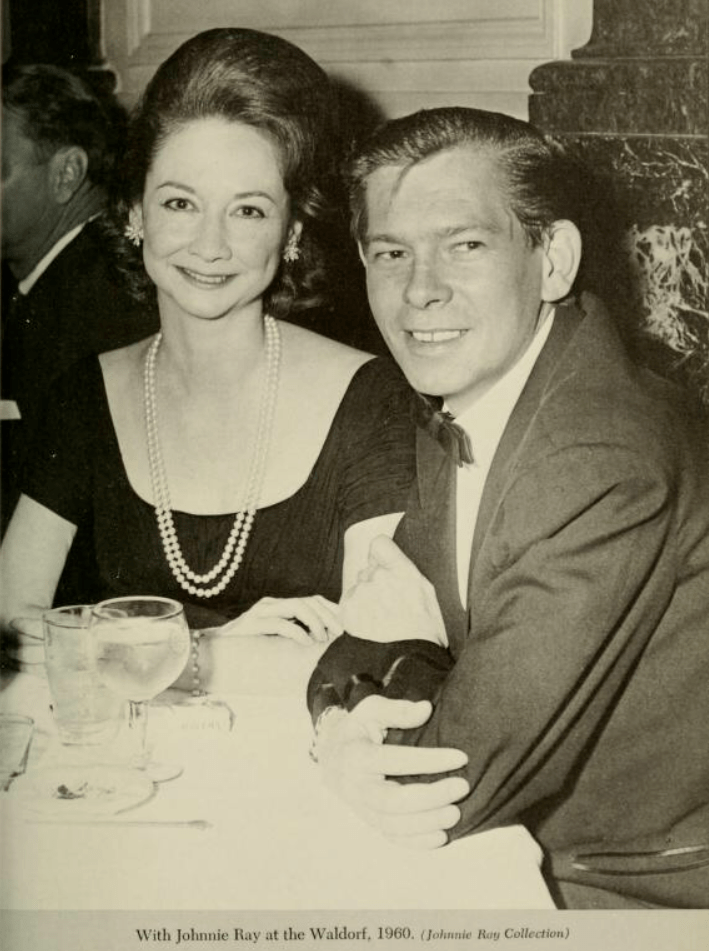
In 1950 Dorothy became a true celebrity when she started to appear on a new TV game show, What’s My Line?. In the following years she would become an integral part of the show. She and her husband also had their own radio broadcast, a scenes from a married life kind of thing. They would record their lovely husband-wife banter morning after morning, even when their relationship was not quite idyllic. She started having an affair with a big star, the teen heartthrob Johnnie Ray.
Even though her journalistic career ended up focusing more on crime and reporting high-profile trials in the later years, she still commented on Hollywood when the occasion called for it. She was very moved by Marilyn Monroe’s death. Interestingly, she did not go the sensational, conspiracy-theory route when reporting on it. She did believe Marilyn committed suicide, or rather, used pills to make her pain go away, if only momentarily, and took too many just to make sure she would get through the night.

The death of a tortured creature from the black shapes of a nightmare into the path of an onrushing locomotive. I think she took a few pills to help her get over whatever her last problem was, and sleepily thought, „Oh THAT feels better,” and took a few more to make sure she wouldn’t wake up until morning came along to make the day safe for her.

That was Dorothy’s theory about what happened to Marilyn. But she went further. And while Kilgallen might not have seemed like the warmest person on the planet, she seemed to really be touched by Marilyn’s death.

This is a story I have known I was going to be writing in the not too distant future. When I first heard Marilyn was dead I said „Oh, no – it can’t be true” which is what almost everyone else said, but as the voice filled in the details I found myself thinking, of course. Of course. This is the way it would have to be… Nude… the pill bottle… the record player. And alone.

Among the things the friends kept asking is, „I wonder why she didn’t leave a note?”… Her life was a suicide note, written for everybody to read, but nobody would believe the message.

Sleep well, sweet girl. You have left more of a legacy than most, if all you ever left was a handful of photographs of one of the loveliest women who ever walked the earth.
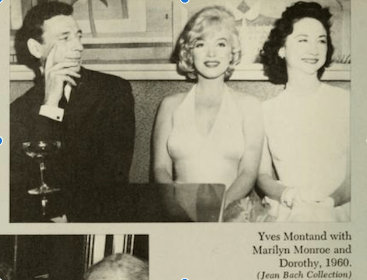
Dorothy Kilgallen does not seem to me like the nicest person. I find a lot of her politics worrying. But I think her empathy towards Marilyn is admirable. It is also, sadly, pretty dark when one considers that she too would die of an early death, alone. But in the end, don’t we all? At least she got to go around the world and be right in the middle of “the things” happening many, many times.

Source of all information, the quotes, and the photo scans: Kilgallen: A Biography of Dorothy Kilgallen, by Lee Israel, published in 1979 by Delacorte Press.
Summer Under the Stars 2020: Day 31 – Alain Delon

It is now August 31st, past 11 pm. Summer Under the Stars 2020 ends in less than an hour. I spent THE ENTIRE DAY watching Alain Delon films. They are LONG. I did it. I am exhausted, I feel like I am unable to think or string a sentence, but I did it. I watched all the movies from my watchlist with this year’s stars (except for two with Barbara Stanwyck, but I still think this is a great score overall). It was quite a lot. Did I have to do it? No. But also yes. Because that is how my brain works. Anyway, here is a list of Alain Delon films I watched today:

Rocco e i suoi fratelli (1960), dir. Luchino Visconti

Plein soleil (1960), dir. René Clément

Le Samouraï (1967), dir. Jean-Pierre Melville

Le Clan des Siciliens (1969), dir. Henri Verneuil

La prima notte di quiete (1972), dir. Valerio Zurlini

Monsieur Klein (1976), dir. Joseph Losey

Nouvelle vague (1990), dir. Jean-Luc Godard

My favourites were Plein soleil (although I still think that I prefer The Talented Mr. Ripley. Maybe I am just not cultured enough. Whatever) and Le Samouraï.

Overall, I am glad I got to experience these pretty iconic works from some of the history’s greatest directors. I just wish I had a better attitude towards the whole thing. And maybe it would have been better to watch some of these by themselves, giving them your full attention. But also, hey, when was the last time you were motivated to just watch a three hour long social issues drama? 

Summer Under the Stars 2020: Day 30 – Charlton Heston

Today and tomorrow the choices for the Stars on this Summer Under Them, are not my favourites. I am thinking about the disappointing shift in Heston’s politics in his later years today. I am going to try not let it influence my opinion on the films. 

Will Penny (1968), dir. Tom Gries

Will Penny is a western, I have seen quite a few movies of the genre this month. This one is, sadly, not among the best. I did like the landscapes and the costumes, but I was so unbelievably bored and I am not even really sure why. The film is less than two hours long but to me it felt like twelve years. I don’t know. 

The Treasure Island (1990), dir. Fraser C. Heston

My criticism towards Will Penny can be extended to The Treasure Island, but this one does not even have the nice landscapes to look at, really. And it is supposed to be a treasure island! But it does have baby Christian Bale, so I guess that is some kind of bonus. 

Tombstone (1993), dir. George P. Costamos

Another western! This one is good! And exciting! It feels like literally everyone is in: Kurt Russell, Val Kilmer, Bill Paxton, Robert Mitchum is the narrator (?!). And the cinematography is beautiful. Tombstone made me feel a bit happy, hopeful for the rest of the films. 

True Lies (1994), dir. James Cameron

A classic. I cannot believe I have not seen it on TV sometimes when I was a child. It is not exactly my thing but it is entertaining. 

I also watched one of his last performances in Any Given Sunday. This one was too much as the final film to be honest. I am as tired as if I played in those games myself. 

Summer Under the Stars 2020: Day 29 – Eva Marie Saint

This is the third-to-last day of Summer Under the Stars 2020. At the beginning of the month I was full of joy and excitement for the perspective of spending the next few weeks with iconic stars and watching tons of classic movies, something that has always brought me joy, every day. And I did enjoy quite a few of those days, I did see some amazing films. But overall, this month has been pretty tough and mostly disappointing. And even though I am NOT AT ALL excited for the Alain Delon day, I acknowledge that most of my frustrations and my unhappiness was caused by external factors. I have been very upset since this morning, when I learned about Chadwick Boseman’s death. My heart breaks for his family. With that added onto everything else that has been going on, I just do not find that much joy in escaping into movies. Honestly, I do not want to do anything. I am going to try to watch as much as possible tomorrow and the day after, because this is what this challenge is all about, but I really wish I was doing it with a more cheerful attitude. 

Grand Prix (1966), dir. John Frankenheimer

This year, during the Oscar season, I was really annoyed with the movie Ford v Ferrari. It just felt so bland to me, and taking into consideration how many movies were completely left out of the race, rewarding mediocrity once again seemed like a punch in the gut. Sure, Ford v Ferrari was not the only offender, probably not even the worst one, but today, after watching Grand Prix for three hours, I just do not think there is a need for more race movies. Let us award something else instead. 

Summer Under the Stars 2020: Day 27 – Claudette Colbert

Torch Singer (1933)

After watching all those movies from the 60s and beyond, it felt really nice to go way back in time for a change. The Claudette Colbert pre-code drama Torch Singer maybe wasn’t the best movie but it was fine and certain aspects of I did find of interest. 

Claudette gives up her baby after the baby’s father goes to China. She is singing in a night club (quite awkwardly, in my opinion), being a generally… controversial woman. But one day, she finds herself singing in a radio show for children which brings on painful memories…

The film is very melodramatic, it is SO pre-code, Claudette’s looks are great. As for her performance, I was unsure at first but she got better and better as the film went on. The scenes with little 1930s kids listening to the radio were adorable. 

Throughout the film I kept thinking about how uncharismatic all the men in it were. The person I found very interesting, though, was the actress who plays Claudette’s maid. After some googling, I found out her name was Mildred Washington and she seems to have been a very intelligent and talented person. And she tragically died at twenty-eight. I want to learn more about these bit players, especially women of colour who never got their due. 

Also watched:

Imitation of Life (1934), dir. John M. Stahl

Several moments made me cringe, I’m still pretty sure the Lana Turner version is wonderful but I think if maybe I’m forgetting things. Should I revisit? Anyway, this one definitely does not come close. 

Cleopatra (1934), dir. Cecil B. DeMille

Claudette looks INCREDIBLY hot, but other than that? Really not much to praise about this one. 

Summer Under the Stars 2020: Day 26 – Laurence Olivier

I am… EXHAUSTED! Laurence Olivier surely took me on a wild ride today to a point where I am going to allow myself to have an early night, I think. But let us start from the beginning…

Pride and Prejudice (1940), dir. Robert Z. Leonard

The day started innocently enough, with a classic Jane Austen adaptation. I enjoyed both Olivier as Mr Darcy and Greer Garson as Elizabeth Bennett (it is weird to me that people think she was miscast). But 2005 version is still my favourite. 

The Magic Box (1951), dir. John Boulting

Pictures that move! Cinema magic! Quite a sad story, and Laurence does not have a big role, but I am glad I watched it. 

Bunny Lake Is Missing (1965), dir. Otto Preminger

A FANTASTIC film. The intrigue is masterfully constructed, the look of the film is on point – I also enjoyed the score. But for whatever reason, I already feel like I need to re-visit it.

Battle of Britain (1969), dir. Guy Hamilton

I have very conflicted feelings about the Polish representation in this film but I do appreciate the action sequences. 

Sleuth (1972), dir. Jospeh L. Mankiewicz

This might actually be one of my favourite films I watched this month. I LOVED the Laurence Olivier – Michael Caine dynamic, it is truly an acting masterclass. I know it is well-appreciated but it still feels underrated.

The Boys from Brazil (1978), dir. Franklin J. Schaffner

Yup. Nazi Gregory Peck having a full-on B-movie fight with Laurence Olivier was not something I expected to see. This is the film that broke me today and…

Clash of the Titans (1981), dir. Desmond Davis

… honestly, after The Boys of Brazil, even Laurence Olivier as Zeus couldn’t faze me. 

Summer Under the Stars 2020: Day 24 – George Raft

The House Across the Bay (1940), dir. Archie Mayo

Today for George Raft’s day on Summer Under the Stars I watched The House Across the Bay. Only this one movie. Fine, okay, two movies: I also watched Jerry Lewis’s The Ladies’ Man in which George Raft has a cameo as… George Raft. Whatever, I had a REALLY tough day, the last thing I wanted was to watch movies, to be completely honest – which in my case is a sign that things are really not going well. So it really did not help that The House Across the Bay was, to put it lightly, very average. 

George Raft plays, surprise, a gangster and the boyfriend of Joan Bennett who is, surprise, a night club singer. Sadly, one day he gets caught and is subsequently sent to Alcatraz. She has to go on without him and gets in all sorts of dangerous situations of her own, with different men. 

There was only one thing I could thing about watching The House of the Bay, only one movie – and not this one. The movie was the one I watched this very Summer Under the Stars during the Sylvia Sidney day – You and Me. I wrote about how much I loved it and how big of a surprise it was for me. All I could think about today was much much I would rather watch that film, instead of the bland The House Across the Bay. Sigh. 

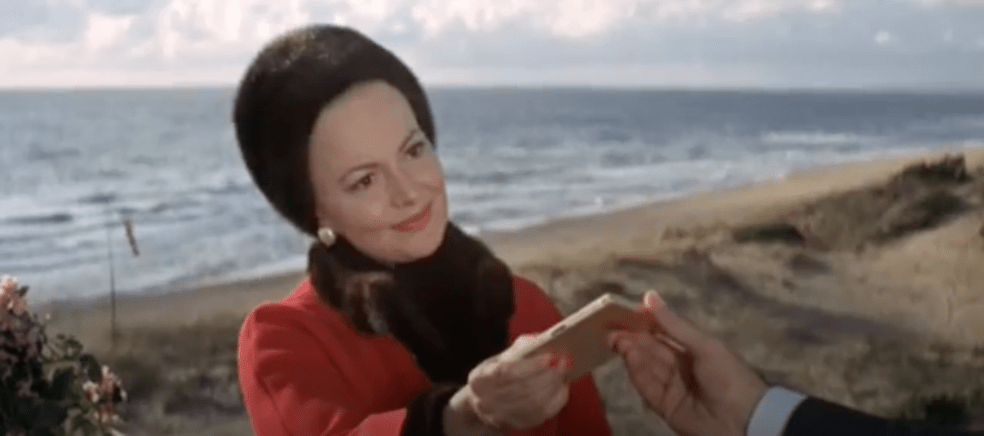
Summer Under the Stars 2020: Day 23 – Olivia de Havilland

And here we are. This is the first Olivia de Havilland Summer Under the Stars Day with her gone. It feels sadder than I expected. I actually watched one movie of hers a few weeks ago already, it was Anthony Adverse and I thought it was dreadful and was very disappointed THAT was the first movie with her I watched after her passing. So I’m happy that at least today I got to see some better things. 

Princess O’Rourke (1943), dir. Norman Krasna

Princess O’Rourke is good! It’s very cute! It’s a classic „Princess’s Day Out story”, with Olivia being the Princess who finds herself among „the commoners”. But as adorable as she is, I’ll admit I found myself a bit bored, which is not a good sign when a movie is just ninety minutes long. 

Devotion (1946), dir. Curtis Bernhardt

Even though a Brontë sisters’ biopic starring Olivia de Havilland and Ida Lupino seems like something tailor-made for me, it turned out to be mostly a disappointment. I feel like the film tried really hard to portray their lives as more dramatic then they needed to be. I would have preferred if Devotion was made Andrea Arnold’s 2011 version of Wuthering Heights, because when it was all about the dresses flowing in the wind on the gloomy moors, it was perfect. I could watch a whole movie of just that. 

My Cousin Rachel (1952), dir. Henry Koster

My Cousin Rachel shares much of its aesthetic with Devotion but is, thankfully, a better movie. I like this story, but the thing I thought was the best was the casting – of Olivia, sure, but I also thought Richard Burton was an amazing choice. 

Light in the Piazza (1962), dir. Guy Green

Light in the Piazza is an interesting one. The main theme of a woman (Olivia) hiding her daughter’s mental disability from the world and facing the consequences of it as the girl comes of age is something I want to reflect on more, I am not sure how I feel about the way the film handles it. What I do know is that Olivia is fantastic in her role, you can really see the years, decades at that point, of acting experience coming through. Plus, the costumes and Italian landscapes are very nice to look at. 

(Also watched The Adventurers (see below) and Airport ’77 but the former drained all the energy out of me so I’m not even going to write a short note for either). 

Summer Under the Stars: Day 21 – Diana Dors

Oliver Twist (1948), dir. David Lean

I actually have a personal connection to Oliver Twist, as I wrote (one of my) thesis on the book. So it is kind of surprising that I have not seen this adaptation before. And it is rather good! The lead actor, John Howard Davies, has this heartwarming/breaking quality which makes him a perfect fit for the role. And David Lean makes some very impressive filmmaking, editing choices that makes his representation of poverty really poignant. Too bad that Alec Guiness’s Fagin is HORRIFCALLY anti-semitic and actually made me cringe when he showed up. And, to be honest, Diana is not the part of the film I am going to remember.

Yield to the Night (1956), dir. J. Lee Thompson

It’s a whole other story with Yield to the Night, though. This movie REALLY surprised me and Diana’s acting blew my mind. She plays a prisoner, awaiting on her execution for murder. It feels like a noir and I’m sure most people would classify it as such, but at one point I started to wonder if it’s just because we look at Diana Dors, looking like a true femme fatale, and we’re unable to see the bigger picture. I am a sucker for unlikable, unhinged female characters. I am a sucker for sad female characters. And the way Diana manages to create such a role, a role of a dead girl waiting was one of the most extraordinary things I have seen in a long time.

Deep End (1970), dir. Jerzy Skolimowski

Too bad she doesn’t get to do something equally great in Skolimowski’s Deep End – here she plays an older woman sexually assaulting a teenage boy, and the film makes sure that we find her as physically repulsive as possible. Well, at least I got to look at Jane Asher a bit, I guess. 

Summer Under the Stars 2020: Day 20 – William Powell

Day 20 already! I’ll be honest, I am a little bit terrified of how quickly the time goes, but at least I have William Powell to make me a little bit happier today. I missed him, I feel like I have not seen any movies of his in ages. 

The Last Command (1928), dir. Josef von Sternberg

The Last Command is a classic, but this, I feel, most people do not really associate with Powell and see it as a totally Emil Jannings picture. This is fair, as he not only is on the screen most of the time, but also won an Oscar (first ever!). But William Powell does not get lost in the crowd somewhere, he is right there and I think he is fantastic. His energy and charisma we know from his talkies is already here. I have not really see him in other silents (other than the rather bad Sherlock Holmes with John Barrymore a few days ago, I guess), but now I wish I did. 

One Way Passage (1932), dir. Tay Garnett

I noticed that Kay Francis pops up a lot this summer (Under the Stars). This is another one of her films and a pretty nice one, with a compelling story, so good for her. 

The Baroness and the Butler (1938), dir. Walter Lang

Mr. Peabody and the Mermaid (1948), dir. Irving Pichel

Absolutely not. I do not need to watch William Powell in an incredibly creepy relationship with a Born Sexy Yesterday mermaid. 

The Girl Who Had Everything (1953), dir. Richard Thorpe

William Powell as Elizabeth Taylor’s father in this very modest (and boring), I would say, B-drama. It really is so weird that Taylor was still doing such nothing movies after A Place in the Sun.

A mixed bag today – but at least I have The Last Command.  

Design a site like this with WordPress.com
Get started