This is something I wrote last year, based on Deborah Spungen’s book And I Don’t Want to Live This Life. Not exactly Hollywood related, but I included a little something about the movie Sid and Nancy so I hope that makes it okay to post here.
Nancy Spungen was born in 1958 into a Jewish family from Philadelphia, the oldest of three children, sister to David and Suzy. Her parents were young, her mother, Deborah, only twenty years old when she had Nancy. The baby had a rough start in life. She was born with the umbilical chord wrapped around her neck which cause her brain to be depraved of oxygen. The doctors took care of her and told the parents that everything was fine with their baby. There seemed to be a number of medical problems with her, though, which in the end the doctors were not able to actually diagnose. She spent the first few days of her life undergoing medical procedures including having her blood drawn with a needle multiple times — she was a newborn with needle marks. She was four days old when her mother was finally allowed to hold her.
When reminiscing on Nancy’s time as a toddler, her parents talk about her screaming. She would just not stop screaming. This is something she never really grew out of. And this is why she started getting prescribed drugs, tranquilizers, at just three months old. That was something she never grew out of either. While it might seem common and normal for a child to get medicine or injections, there is a chilling image forming here when one thinks about Nancy’s future and they way her life unraveled before her tragic death. But the biggest problem with Nancy in the following years was her violent, aggressive behaviour. There was something her family noticed in her whenever she would start one of her tantrums, something they called The Look. Her face would change and they new something bad was going to happen.
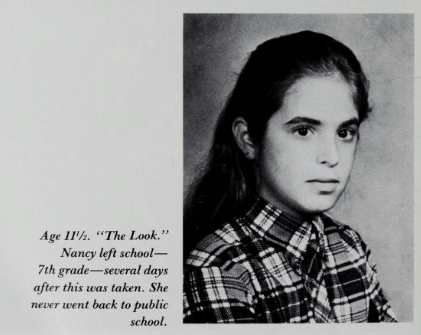
Raising Nancy proved to be difficult, her tantrums were growing bigger and more intense. From her early age her parents seeked medical assistance, including psychotherapy. The doctors’ and psychologists’ verdicts were consistent — Nancy had some trouble developing her motor skills but she had an above average intelligence. This meant she was doing great in school, in fact, she skipped grades and was in courses from higher grades as a child (the only subject that was causing her problems was maths). This also meant she was not able to enroll in a school equipped to deal with children with her kind of behavioral issues — these schools were only accepting students with intellectual disabilities. And this is why for the longest time the doctors assured the Spungens that there was nothing wrong with their child, that she was just acting out and all that would pass.
However a time has come when Nancy had to start seeing a therapist regularly because dealing with her proved to be next to impossible. And her parents wanted someone to help them, sure, but also hoped that somehow they can make Nancy’s life a bit less hard for her. The therapy did not really help in a significant way, seeing as her behavior did not improve. It did not improve after she was enrolled in a boarding school specializing in „difficult” kids either. There were moments when she seemed to be getting better but never did they last. She was barely a teen when she started smoking pot and claimed to have tried acid, and not long after she introduced marijuana to her siblings (her brother was a stoner at just twelve years old but managed to stop, as to not become like Nancy). She would be nice for a moment but turn into a screaming “monster” as soon as things stopped going her way. At least in the boarding school she was seeing psychologists multiple times a week. But then there came a time when the school administration has changed and nothing was the same. She was transferred to a school where one teacher “took care” of a group of teenagers by herself. Her parents recall driving their daughter to that place and seeing a group of hippie teenagers roaming around in a haze, with no adults in sight. Nancy would not see a therapist there for months. She could access drugs easily, though. She also met her first boyfriends. And the way she handled these relationships would continue on in her future affairs. One thing she seemed to do was take on personality traits and quirks her boyfriends had. She would model herself on whoever was giving her attention a the time.
At fourteen Nancy was harming herself and attempted suicide. In fact, suicide attempts would happen multiple times in the following years. Deborah found an alternative medicine specialist who seemed to “get” what was wrong with Nancy and was ready to help. While “alternative medicine” is something one might be skeptical of, we are never going to find out whether this therapy would be of help because Nancy’s school would not allow her to take a few weeks off to go to the clinic. And the Spungens did not want to jeopardize Nancy’s education. And, weirdly enough, despite all her problems, her school, the place which was supposed to help her and where people knew how to deal with people with issues similar to hers, decided it was time to let Nancy go. She was just sixteen when the school arranged for her to taker her SATs (without informing the family). She was advanced in all subjects except for maths so they decided it was time for her to graduate. Her parents did not find out until after she was accepted into a university in Colorado. And they let her go — they knew their protests would prove futile, Nancy would always have her way.
The university life seemed to be good for Nancy for a while but, like everything good and constant in her life, it did not last. During her first months at school she was arrested and subsequently expelled. So she came back home. And while Deborah Spungen seems to have loved her daughter and truly wished to have helped her, she also admitted that life was much better when Nancy was away. And back in Philadelphia Nancy made everything worse again: she was self-harming, she was trying to get her siblings to do drugs, pressuring her sister to lose her virginity, she was bringing strangers into the house and doing drugs with them, and she was threatening her family’s life. Literally. She could actually take a knife and say she was going to kill them. While she always had a lot of affection for David, even “protecting” him from the rest of the family (when there was not really anything for him to be protected from), she seemed to be really angry and resentful of Suzy. Her sister’s life would be really tough when Nancy was around. In the end, they decided to let her go for good.
Nancy’s parents told her she was going to move to New York. In addition to all the pain she was causing them, she was not able to hold onto a job in Philadelphia, nor did she have any plans to try and get into university again — it was time for her to become independent. They would pay her rent for six months and support her for another six. Nancy was happy about the idea and she quickly found a cheap apartment near Chelsea Hotel (which seems sinister in retrospect, considering she would begin her life in New York right next to where her life would end). When Deborah visited her daughter for the first time she was delighted — Nancy seemed to be thriving. Her apartment was nice and clean, she had a kitten, and she was looking for a job while also devoting time to her passions, like writing about rock music for local magazines. She published reviews in independent Greenwich Village rock magazines and the Spungens were actually impressed with their daughter’s work (unfortunately, I was not able to find any of said reviews, which is a shame because I would have loved to read them).
It made sense for Nancy Spungen to get into (or, try to get into) the music business. Nancy loved music ever since she was a child and listened to her parents’ recording of Hair for the first time. At one trip to New York there was a performance of Hair in the Park. Nancy managed to get away from the family to get close to the music and, which gave them quite a fright. In many violent periods of Nancy’s childhood and adolescence, the one thing that made her happier and calmer was music. She would play her parents’ rock records, and later the ones she bought or received herself, on maximum volume over and over and listen to them, just sitting there, maybe smoking, but overall less aggressive. Her family would hear the extremely loud music throughout the day and night but they didn’t interfere — at least Nancy seemed better. In Philadelphia, Nancy would go to concerts on the weekends and that’s where she started meeting musicians. She once claimed to have met Queen backstage. Apparently she also spent some time with Aerosmith. After her move to New York she would hang out with musicians as much as possible, even, according to her, formed a friendship with Debbie Harry before Blondie got big. Nancy seemingly had a talent for seeing the potential of artists before they got big.
In addiction to seeking out new acts, she also tried to find a boyfriend. And her crushes were intense. At one point, she followed a boy to England. And while it did not work out, in London she met a band no one has heard about in the US yet — a band called the Sex Pistols.
When she talked about the Sex Pistols on the phone with her parents she made them seem like geniuses who were about to change music forever. Deborah seeked out everything she was able to find about the band and was, well, shocked. To her what Sex Pistols did had little to do with music and she thought none of the band members had any talent at all. David and Suzy seemed to agree. Interestingly enough, David thought Sex Pistols were talentless hacks, but knew they would become a big deal — if Nancy said so, so it would be. And he was right — she was right. One evening the Pistols’ performance was broadcasted on American TV. The Spungens sat in their living room to try to see what Nancy saw in them. They did not understand. In fact, they all seemed a bit disgusted. The biggest shock was not the band, though, it was Nancy who they spotted in the crowd. And they did not see their daughter in it, they saw a scary, violent monster. And in her eyes they saw The Look.
Nancy had boyfriends throughout her teenage years and she could be intense in all her relationships with men. But she never before fell as hard as she did for the Sex Pistols’ Sid Vicious. He was a tall, skinny twenty-one year old from England who was not generally considered to be the brightest or the most talented. His mother was a drug dealer who introduced her son to heroin pretty early on in his life. And Nancy thought he was the sweetest and most amazing person on Earth. And he evidently felt strongly about her as well. And so began one of rock’s most iconic love stories, the story of Sid and Nancy. Much has been said and written already about these two, the punk icons who personified the generation’s philosophy. I do not feel like I have anything to contribute here and this article is not supposed to be about Sid. I believe there was love and affection between them but their addiction was much stronger. What is important is that it became easier for Nancy to access drugs when notorious Sid Vicious was by her side and it was easier to be high all the time. The most intense period of her short life was in full swing and the tragic end seemed inevitable. To the people closest to Nancy it was less of a scary sign of the things to come and more of a logical conclusion, something they have predicted would happen for years.
Deborah believed her daughter had neurological damage resulting from her problematic birth. Nancy was examined by many doctors throughout her life. Deborah never learned much from them. When Nancy had her crying outbursts as a baby, the specialists said it was natural and she would grow out of it. When she did not, when it was time for her to go to school and she was causing problems there, they said she did not receive enough warmth and attention from her parents. When she was doing drugs and causing harm to herself and others as a teenager, the system concluded it was time to let Nancy go and let her leave school at sixteen. It wasn’t until after Nancy’s death that Deborah acquired documents from the examinations and doctors’ evaluations that her daughter have been through. While they were not conclusive, there were multiple references made by medical professionals to Nancy possibly being schizophrenic. She also read up on children with behavioural issues similar to that expressed by baby Nancy and found that many of them also had difficult births. She spent years trying to find answers and possibly something that could show her Nancy’s death, Nancy’s life was not her fault.
After Sex Pistols broke up not too long after they became a phenomenon, Sid and Nancy came to New York. Nancy did not forget about her love of music and her desire to become a part of the industry. The logical thing was to try to become a manager – and she had her boyfriend, a punk sensation who needed someone to manage his career. This gig did not work out. There was an iconic „My Way” performance by Sid Vicious solo, there were some concerts but his career was not exactly flourishing. Not only was Sid, objectively speaking, not the most musically gifted person on Earth, he also did copious amounts of drugs every day which made it difficult to try to function. And Nancy was doing the drugs as well. But it did not stop them from making a trip to Philadelphia where Sid would meet his girlfriend’s family for the first time.
Nancy and Sid arrived at the Philadelphia train station and they were a sight to behold. The Spungens were shocked and really quite scared of the way their daughter looked — she showed up with torn up clothes, extremely thin physique, and her chestnut brown hair bleached white. The man who accompanied her was not the monster who scared Deborah when she saw Sex Pistols perform on TV. He was a tall and skinny guy who seemed to her like a kid. He seemed less intimidating and more deserving of pity. The visit was a disaster. Nancy kept babying Sid and expected her mother to do the same. All Sid wanted was to watch TV. They were trying to have a nice time and things went smoothly for a moment but it did end with an eruption. The last thing Nancy said to her sister Suzy was a death threat. During a family dinner at Sid and Nancy’s last evening in Pennsylvania, Nancy thought Suzy looked at her weirdly. So she said she was going to kill her. The family was used to Nancy exploding like that, it was not the first time. But it would be the last. Deborah Spungen recalls how Sid and Nancy’s eventful visit ended:
We drove in silence for a while. Then out of nowhere, Nancy quietly said, „I’m going to die very soon. Before my twenty-first birthday. I won’t live to be twenty-one. I’m never gonna be old. I don’t wanna ever be ugly and old. I’m an old lady now anyhow. I’m eighty. There’s nothing left. I’ve already lived a whole lifetime. I’m going out. In a blaze of glory.”
Then she was quiet.
The London and New York eras of Sid and Nancy’s short life together was presented in the 1986 Alex Cox film Sid and Nancy. While, after the break up of Sex Pistols, Nancy enjoyed calling herself Sid’s manager and tried to convince every one that she was going to make him a big star (maybe she even believed that that was going to happen herself), the film presents the reality probably much closer to what actually happened. Who knows if Nancy was serious about being a music manager. I think she would often get really excited about something for a very short while just to completely abandon it as soon as any little thing does not go her way (which is such a relatable trait, but much more dangerous when it comes to someone like Nancy). She did try to score Sid some gigs and his (in)famous performance of My Way happened during that period. But they quickly accessed drugs and stopped caring about anything. I believe that the film scenes showing Sid and Nancy sitting quietly on the bed in their hotel room, surrounded by trash, watching TV all day with vacant stares is a good representation of what their final days probably looked like. In Deborah Spungen’s book she recalls a sad realization she came to one day: Nancy stopped reading. She did not open a book or even a magazine in months. She was always said to be very intelligent and she did enjoy entertaining her brain. Drugs changed that.
I remember seeing Sid and Nancy for the first time when I was a teenager, obsessed with the music scene and attracted to the darker side of life. Sid and Nancy were glorified in a way by „alternative” kids, their photos all over Tumblr and (oh my God) weheartit. I remember being, really quite offended at the fact that Chloe Webb was the actress playing Nancy. I thought she was too old and, unfortunately, and I do feel embarrassed and guilty about it now, too ugly to play Nancy who, at that point, I really did not know that much about but still considered her an icon for myself. I loved Hole back then (still do) and I was angry that Courtney Love, who was in the film, was not the person playing the main character. Interestingly enough, I do not think I had anything against Gary Oldman as Sid Vicious, even though he was almost thirty and with not much of a physical resemblance to Sid. Chloe Webb was almost Nancy’s age and while not a spit image of her, still pretty similar. Funny how that works. I re-watched the film a few days ago, after reading And I Don’t Want to Live This Life, and now, in my 20s and my view of Sid and Nancy as people and Chloe Webb’s performance has definitely changed. Maybe she could have been a bit more aggressive, a bit more feral, but I still think she pretty much nails the lost woman heading towards her own destruction. Her way of talking is also pretty similar to the short snippets of Nancy talking captured on video. I also really appreciate her voice acting, if you will, and the way she plays the frustration. Oldman, on the other hand, plays the confused kid Sid well but completely loses the angry side of him. And while Nancy might have considered Sid a sweet boy, we know from the people who knew both Sid and Nancy that he could get extremely violent. He’s a child, which is appropriate, but not a punk icon.
The film focuses on him much more than it does on Nancy. It is not too surprising or problematic, really, it starts with their meeting and shows their life together — and their life together took place in the punk world, the world that Sid was (is?) considered the biggest icon of. The one scene that is truly “Nancy’s” is the one where she and Sid visit her family. This is the story recalled by Deborah Spungen in her book (and me, earlier in this article) but the one in the film is quite different. They are visiting Nancy’s grandparents, not parents, and meet Nancy’s cousins (I assume) who were not part of And I Don’t Want to Live This Life. Nancy’s parents and siblings are in the scene but only as extras. And Nancy throws a tantrum, something that allegedly actually happened. But the scene does not seem like the one in the book, where Nancy’s outbursts and honestly, her behaviour in general, during the visit reads as scary and sad — it is juxtaposed with the family who is watching their sister and daughter who seems like a monster, not a real person, they realize they lost her and probably are not going to get her back again. The scene in the film shows aggression and shows how uncomfortable the family is but, maybe because we do not know anything about Nancy’s family in the film and cannot exactly read their emotions, there is something borderline comedic about it. Chloe Webb nails the scene in which Nancy calls her mother from London and tries to convince her she and Sid got married and she must send them a wedding gift (money), though.
Nancy Spungen was killed by a single stab wound to the abdomen. She was twenty years old. She was staying at the Chelsea hotel (the place they lived in together) with Sid Vicious who was arrested for her murder but later released on bail. He would be dead before the trial. He claimed to have loved Nancy for the remainder of his short life and called and wrote to Deborah to talk about her daughter. Deborah Spungen believes that while Sid was the person who delivered the fatal blow (a fact questioned by many throughout the years), Nancy manipulated him into killing her. What she thinks happened was that Nancy bought the knife that would be the end of her and swung it before Sid saying that if he really loved her, he would help end her misery and that there could be no bigger proof of eternal love than ending your lover’s life (and then your own, possibly), so that you could be together forever in death. She believes her daughter spent her life wishing she was dead. Several people claim she and Sid had a suicide pact and that his death was somehow a part of it (maybe even aided by Sid’s mother who made it happen).
While writing this article, I watched a 2009 documentary Who Killed Nancy? directed by Alan G. Parker. I have not seen it before. And for a film that has her name in the title, it really does not talk about Nancy all that much. It consists mostly of people’s memories of Sid and only the last fifteen minutes or so is devoted to the titular question (the filmmakers and interviewed people seem to believe Nancy was murdered by a drug dealer they did not even really know and there was no way that drugged out Sid could deliver the fatal stab). Anyway, there are a lot of people from Sid and Nancy’s social circle interviewed in the film and their opinions on Nancy are pretty similar. And they are similar to things shared by Deborah as well. Nancy is being referred to as the worst person, a monster even, a person no one wanted around. Only one friend of Sid, a Sex Pistols super-fan, Hellin Killer said that when she met Nancy for the first time she was shocked because she seemed really sweet. She stayed with them in London and while their lifestyle was sad, Nancy was always nice to her.
Even though I do not think there is a reason to distrust the reports of Nancy’s erratic, violent behaviour and even causing actual harm to others, I still cannot help but feel really sad about the way she seems to have been viewed by others. I wonder if Nancy knew that she was seen by others as a lost cause. I think she must have. And I cannot imagine what must happen for a parent to just give up, to accept that their child was not going to make it and all they can do is to watch it self-destruct. I do believe that Deborah genuinely loved her daughter and I do believe that she did everything she could to help her. It is too tragic that the people and institutions who could most likely actually make a change in Nancy’s life turned out to be incompetent and aided her ultimate demise. I hope Nancy got to experience love and warmth. I do not know if that is what she got from Sid. I know she thought she did and maybe that is all that mattered. One can speculate about these two: would things turn out different if they did not find each other? Or were they the one last shred of hope, the one last bout of happiness for one another? It is probably pointless to wonder about that. All I hope is that history can look at Nancy Spungen and her life with just a little bit of understanding. There is no point in hating her — although, to be fair, among the rock girlfriends she is probably among the ones who provoke the least amount of scrutiny. People see Nancy as a rebel and punk icon and I think she would like that. Let us not forget about the pain she seemed to have felt all her life, though. Sadly, I think we can all relate to that, even just a little bit.
Information, screengrab, and quote from: And I Don’t Want to Live This Life, by Deborah Spungen, published by Corgi Books in 1983.
 Swingin' at the Seance