Luca Guadagnino’s 2018 remake of Dario Argento’s 1977 Suspiria was one of the most talked-about films of last year among film enthusiasts. As soon as the project was announced (or, in a way, even before that, considering the remake was planned for years and there was always something stopping it from actually being made) people began to speculate about it and the more and more we learned about the production itself the more questions and worries were being brought up. And then the film was made. And then it premiered. And the reviews and reactions were said to be mixed. Personally, I would say there were mostly positive, considering that people either absolutely loved it and were in awe of seemingly every aspect of the film, or they praised a lot of its elements while voicing concerns that were less of a simple bashing of the film, and more of a wish for it to have expended on its themes and allegories that the critics felt maybe Guadagnino did not explore enough. Still – they did notice them and they did notice the depth of the film.
To proceed with my own thoughts about Suspiria, I need to be direct about something – I consider the original film, the 1977 version by Dario Argento, my favourite film of all time. Yes, THE favourite. I am not even sure if this is actually true, or should be true. There are probably films I saw more times, there are films I love that are objectively more influential or groundbreaking, maybe better acted or written. There are other films that I could name as my favourites that would give me more respect among the film crowd. But I remember seeing Suspiria for the first time as a teenager and feeling like my whole life has changed and to this day I have not been able to experience what I felt surrounded by that music, that colours, that nervousness of not being able to say what it is that is happening as I am watching a young girl running through the dark rainy night in a German forest again. So even if I could sit down and maybe be more honest with myself, choose another film that could be a better representation of My Favourite, I am not going to. I am okay with the decision I made years ago when I chose Suspiria (1977) as my favourite film of all time.
It was important to me to not let this affection I have for the original film to cloud my judgment of Suspiria (2018). Guadagnino’s previous film were not exactly my cup of tea – I did not like I Am Love nor A Bigger Splash. But then I watched Call Me By Your Name and I did understand why people liked him because the film was truly beautiful. Maybe there was hope for Suspiria after all. But then it came out and I heard a lot of praise from a lot of people I did not trust in being fair to the new while also respecting the old, meaning: I thought those people had no idea what Suspiria was all about and got charmed by Guadagnino’s visual tricks. Alternatively, the new film resembled the original so much that people who did not see the 1977 version thought they were watching something fresh and innovative not realizing Suspiria already existed. Those were not good thoughts to have before seeing a film one wanted to be fair to, so I decided to wait. And I waited. And waited. And then a whole year has passed. And I finally decided it was time this Halloween season (or, if you prefer putting it that way, this October).
I would like to shout out the podcast Gaylords of Darkness here. They are horror lovers, very appreciative of the original Suspiria, very knowledgable in the subject, and they LOVED the remake. „Loved”, even capitalized does not even begin to cover it. They are absolutely obsessed with the film, at this point I think they have dedicated four episodes to it. So they talked a lot about all the reasons why Suspiria (2018) is pretty much a masterpiece. And I knew that those are people I could actually trust – so I thought it was time. I watched the film.
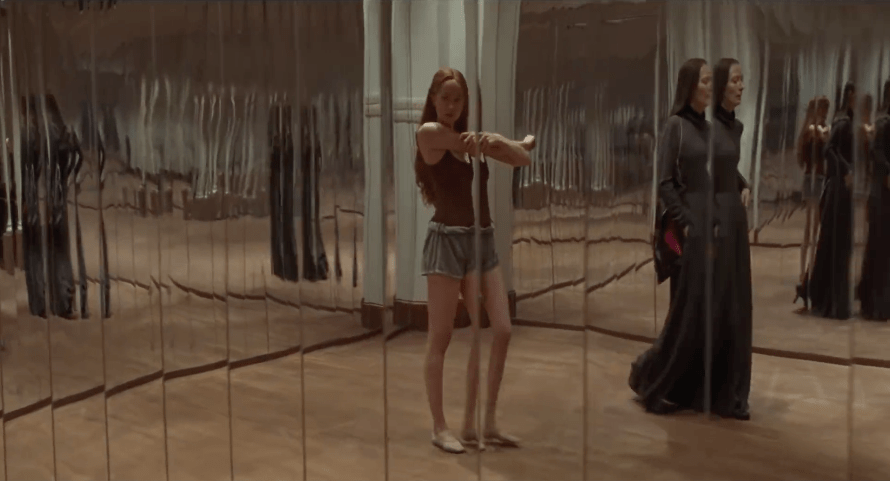
It started kind of oddly, a confused girl is visiting her therapist, she is saying weird, creepy things, it is all dim and grim, well, it started like a lot of modern horror films do – with a creepy cold open. Then we see Dakota Johnson, our new Suzy Bannion. Like Jessica Harper forty years ago, she has just arrived in Germany. She does not have Jessica Harper’s eyes, her face full of wonder but also nervousness, uncertainty about the future. She looks kind of calm, determined. When she arrives at the dance academy (this part of the plot does not differ from the original, both Suzys are aspiring dancers) it is not what it was in the 1970s. While people have been praising the production design in Guadagnino’s film (rightfully so), it is completely different from the colorful extravaganza of Argento’s original. The new Suspiria, the cinematography, and the world of that story is pretty grim, toned-down, dark, and earthy. This is not a criticism, just an observation, and the fact that the colours here are dim and cold only makes the richness of reds when they do appear even more prominent. But those colours are a dead giveaway that we are not in Argento land anymore. Another sign is the music. Goblin’s 1977 score is iconic, creepy and exciting, with the whispers mixed with electronics. There are some wonderful musical moments in the new Suspiria as well, but they do not compare in my taste. And I actually do want to complain here: Thom Yorke’s original songs did not work for me at all. They felt awkwardly out of place, did not fit the world of the witches of the academy, nor the 70s Berlin.
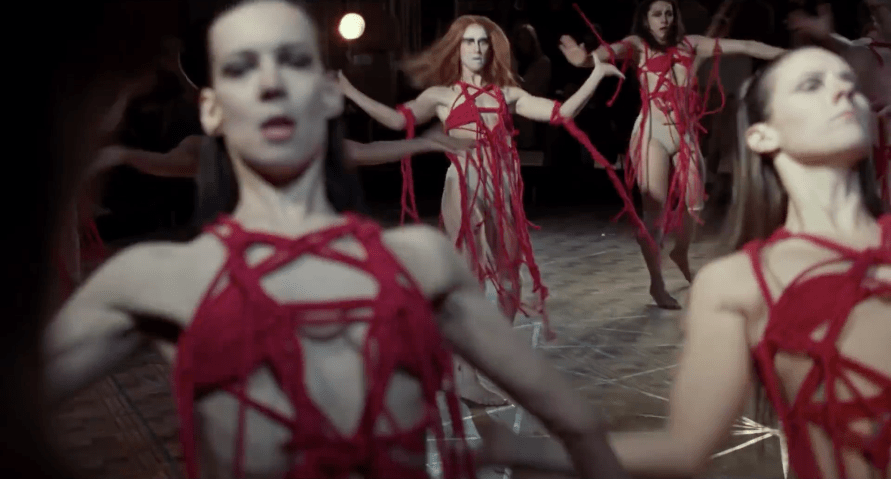
And the 70s Berlin, the atmosphere of the divided city, the political unrest of the era are important parts of the new Suspiria. Or, are they? Guadagnino reminds us periodically of where we are. Olga, a student of the academy, after Patricia (the girl from the beginning) „quits” the school, accuses the professors of being neutral while their country is going through such important changes. Guadagnino also does it with not-so-subtle-at-all shots of TVs showing the news about terrorist organizations bracing up. The time and place, this specific time and place surely matters a lot to him and he wants the viewers to realize that. History seems to be incredibly important to the world of Suspiria. There is personal history, like Suzy’s life in a religious compound in the US, there is the world history, like aforementioned tumultuous events in 70s Berlin, and there is a place in which personal history meets the historical events. And this is where we get the cameo.
Jessica Harper has a cameo in this film. She plays the long-lost wife of the only man in the film, Dr. Klemperer (the therapist Patricia sees in the beginning, played by Tilda Swinton). She comes back to him one night, when the students’ big performance is happening. He thought she died in a concentration camp during the war but now she is standing in front of him. This is an incredibly touching but also loaded moment – we are seeing supposedly a victim of the Holocaust, who, as it turns out, actually survived miraculously. But we are also audience members getting a „present” of sorts from Guadagnino: look! It’s the actress from the first film! Are those two situations comparable? I would say no. Am I being nitpicky for no reason at all? Possibly.
Guadagnino introduces all these broader contexts, all these historical moments, dramatic, tragic moments, and he makes sure we notice. And we do – but what comes next? The prevailing (confirmed?) theory seems to be that he tries to warn the audience about the dangers of people in power abusing said power. The teachers at the academy are the coven that sacrifices their students for their own interest, to make their magic more powerful. Is Nazi Germany really something that fits well with such themes? I find separating Nazi ideology from the inherent antisemitism, racism, homophobia – and those are VERY weak words for what Nazi ideology actually is, and boiling it down to „abuse of power” a stretch at best, and a total disrespect at worst. As for the context of 70s Berlin, I actually appreciated Olga calling the teachers out for shutting themselves away from the real world changes happening. Maybe the theme of apathy and „neutralism” in the context of political tumult would be a theme worth exploring?
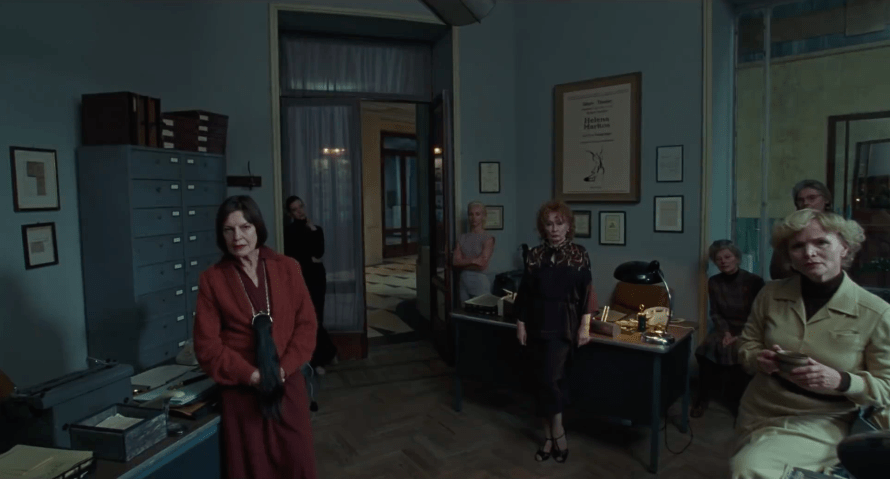
And I guess we cannot escape talking about something else when it comes to the abuse of power by the convent: is fear of powerful women a part of this all – is Suspiria misogynistic? All the witches are women, they are extremely powerful and extremely cruel. I guess women watching women in power portrayed as something wrong are deemed to be suspicious, maybe even hurt, since this is still not something we get very often. But there is also the most powerful of all, Suzy – a woman and a force of justice. Is that alright, then? But then almost all of the women who played a larger part in the film die and they die in a horrific manner, Then again, this is a horror film. But there is a person who gets to have a gentle ending. And he is a man. Dr. Klemperer gets to live. His wife did actually die, but it is not that painful, since his memories get erased. He also gets told that none of the evil is his fault, those in power are always at fault. How is that for a message in 2018, a year in which staying neutral, not rebelling against the oppressors seems like a slap in the face for those underprivileged?
The aforementioned „epilogue”, Suzy coming to comfort Dr. Klemperer after she annihilated the coven feels very bizarre and out of place for the film. The man being the one person whose faith seems to be the easiest does not fit in with my version of female-led story. One might say Olga, Patricia, and Sara get a „happy ending” of sorts, since in the finale Suzy allows them to die peacefully in her arms, in opposition to her ending the teachers’ lives in pain and torture. But let us not forget that earlier in the movie they did actually have to endure horrific torture. The not-Pina-Bausch character of Tilda Swinton seems problematic (as in: posing problems causing one to wonder about them, I am not necessarily using this word in a Tumblr way). She does not seem like your typical strong mentor type, Suzy seems to get a hold on her pretty early on. She is destroyed as well but maybe the fact that Tilda Swinton plays Dr. Klemperer as well is significant? Maybe she does get a redemption of sorts – if only through him? (Disclaimer: this is just me brainstorming. I do not think that, to be honest).
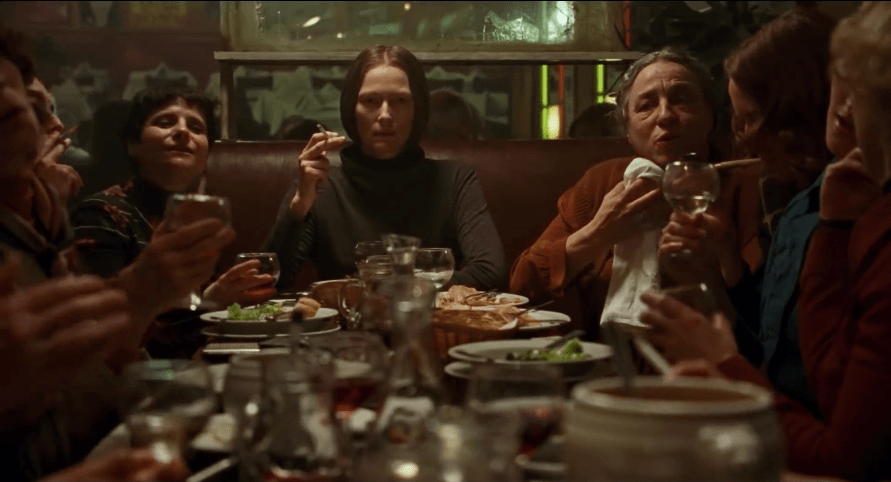
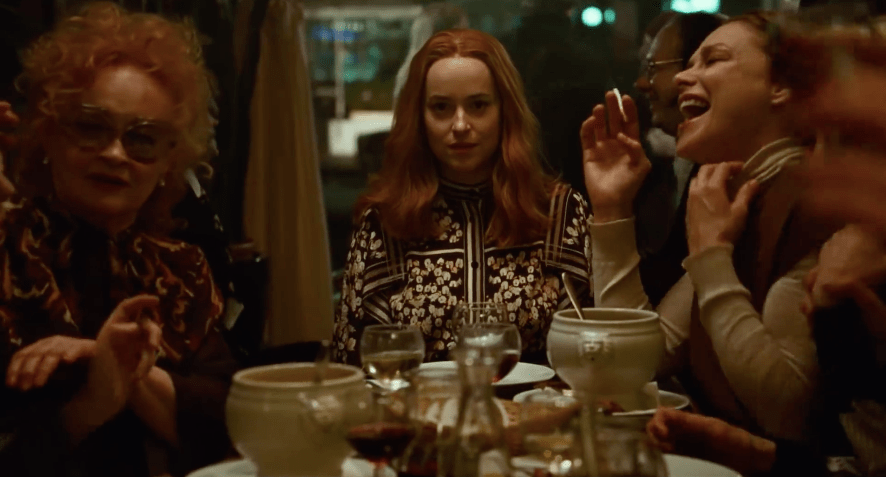
I also have some thoughts that are definitely nitpicks and I could be thinking too much about this. But hey, if Guadagnino gets to make a heavy piece of arts with metaphors and references galore, why can’t I actually give it a lot of thought? I could not help but think a little more about Suzy’s nationality than I did in the context of Argento’s original. She is an American which, of course, is most likely due to aforementioned original Suzy, but also to Dakota Johnson herself. But in this heavily politicized remake one wonders about the implications of an American coming to Europe and „taking care” of our bloodthirsty (literally) despots. A throwback to the imagery of American soldiers arriving from across the Atlantic and defeating Nazis, perhaps? And the whole fact of Germany as the land of authoritarian tyranny: of course, this is not wrong. But Guadagnino (like Argento before him) is from Italy – not exactly the land separate from the fascist ideology. Maybe one could have looked closer to home to pick up on certain elements of the metaphors of Suspiria?
I do believe that Luca Guadagnino had a lot to say with his film. The problem is, I think, that he was okay with dropping hints about the things he would want to present without actually expanding on his ideas. As a result you have people who praise the film for things it did not even do, and people bashing it, possibly, unfairly (like myself?). There is also a large group of viewers who were absolutely in awe of the film’s visuals and that was enough for them. I have read reviews that did not touch on the political context (or subtext) at all. Maybe that is alright as well. Maybe, oddly enough, the key to enjoying Guadagnino’s work is completely ignoring his attempts at saying something more meaningful and focusing on the film language alone. Maybe that is what I should have done in the first place. Maybe I should have skipped the film. Maybe I am right about some things.
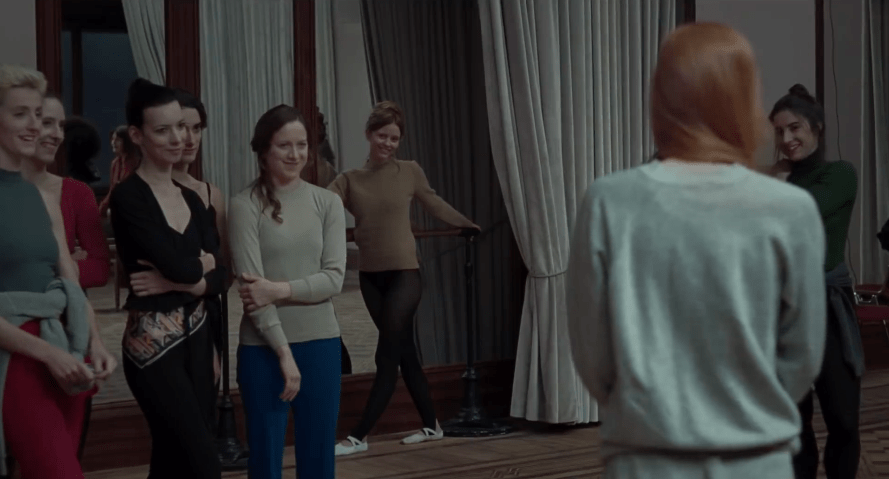
Maybe Guadagnino’s Suspiria is not worth criticizing. After all, we live in a world in which Mother of Tears* exists.
*Having said that, I genuinely enjoy it as a bad film.
 Swingin' at the Seance